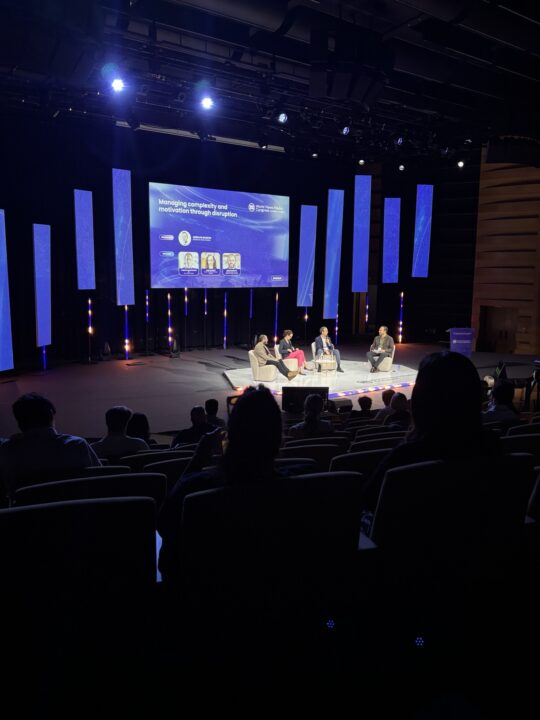
The search for effective AI tools to optimize newsroom workflows has become a top priority for today’s media executives.
Artificial intelligence is no longer a vision of the future. It has become part of the daily operations of modern newsrooms. From automated content creation to AI agents that support investigations and analytical reporting, new technologies are transforming the way journalists work. But how can AI be integrated into editorial processes without compromising the quality of journalism?
We spoke with Aleksey Lazarov, co-founder of Visibilio.AI and former Editor-in-Chief of Капитал, about the opportunities and challenges AI presents for media organizations. Lazarov was also one of the key experts who tested and contributed to the development of NewsBuild.ai, the AI-powered newsroom automation platform developed by the Net Info team.
Interview by Elza Todorova-Klisarska
Artificial intelligence is no longer a topic for the future. It has become part of everyday newsroom operations. From automated content creation to AI agents supporting investigations and analysis, technology is changing how journalists work, but not the purpose of their profession.
What are AI’s real strengths and limitations in journalism? Can a newsroom remain competitive without these technologies? And which human qualities will remain irreplaceable regardless of how advanced language models become?
We spoke with Aleksey Lazarov, co-founder of Visibilio.AI, an experienced journalist, and one of the professionals actively working on integrating artificial intelligence into editorial workflows.
The Advantages of NewsBuild.ai in a Traditional Newsroom
Mr. Lazarov, you worked with Net Info’s team on the development of NewsBuild.ai. What were the biggest strengths and weaknesses you observed?
I only saw strengths.
The biggest advantage is that AI tools create enormous opportunities for journalists in several areas. They help them work faster, produce more content without sacrificing quality, and most importantly, free them from repetitive and tedious tasks.
That gives journalists more time for what truly matters: discovering important stories, pursuing meaningful investigations, and producing original reporting.
Very few people become journalists because they dream of compiling short news updates all day in front of a computer. Yet over the past decade, that routine work has become a major part of the job.
AI tools now make it possible for technology to handle the repetitive work while journalists return to the exciting part of the profession.
Optimizing Newsroom Workflows with AI Agents
What is the biggest challenge when introducing AI into a traditional newsroom?
The greatest challenge is preserving journalism’s real value, which cannot exist without fundamental human principles such as freedom, truth, and honesty.
Using AI tools without those principles, and without understanding what makes journalism valuable, is a recipe for failure.
Many people today worry about AI slop, the meaningless output produced by language models. What is often forgotten is that there has always been an enormous amount of human slop as well. Journalism without principles, ideas, or direction existed long before AI arrived.
What does it mean for newsroom content to become AI-resistant? What are today’s biggest challenges for media organizations?
For more than a decade, the biggest challenge has been finding a sustainable business model.
Artificial intelligence makes that challenge even greater because the amount of content being produced continues to explode while its commercial value moves closer to zero.
In the short term, one of the most important tasks for media organizations will be learning how to structure and deliver information for AI agents.
Today, bots already account for more than half of internet traffic, and that trend will continue.
First, bots learned to write like humans.
Now humans must learn to create content that AI agents can efficiently understand and process.
How would you explain an “agentic workflow” to someone who doesn’t work with AI every day?
It is simply a sequence of tasks carried out by multiple AI agents that communicate with one another and coordinate how to complete a specific job.
Security Risks: Why Free ChatGPT Is a Double-Edged Sword for Businesses
In one of your LinkedIn posts, you wrote that Bulgaria ranks among the countries with the highest per capita usage of ChatGPT, even ahead of the United States. You also suggested that this widespread adoption is driven more by individuals than by corporate AI strategies, creating a double-edged sword because large amounts of internal company information are already ending up inside AI models. Could you elaborate?
AI adoption in Bulgaria is clearly widespread among individuals who use these tools extensively in their daily work.
The problem is that most companies have no governance over this process.
Everything entered into ChatGPT, Gemini, Claude, and similar consumer AI tools becomes part of the model’s memory.
Internal business information, personal data, financial analyses, and confidential documents entered into public AI systems remain there permanently, creating significant risks for organizations.
Can a newsroom survive today without AI?
No.
In reality, it already isn’t.
A few months ago, we analyzed several major Bulgarian media outlets to estimate how much of their content was generated with AI.
Depending on the subject matter, the figures ranged from 20 to 80 percent.
The percentages were lower for domestic news and analysis, and considerably higher for international and entertainment content.
I believe those numbers are even higher today.
Content generation is only one aspect.
Using multi-agent workflows for investigative journalism opens entirely new possibilities.
BBC recently used such an approach in an investigation into Russian propaganda, and the results were excellent.
The Future of Journalism
What advice would you give journalists and editors preparing for the future? Which qualities will matter most?
The qualities that mattered in the past will remain the most valuable.
Real journalism can exist only when it is built upon simple and enduring principles such as freedom, honesty, and dignity.
What is the biggest misconception about AI’s impact on journalism?
That AI will completely replace journalists.
Do you see more fear or more curiosity among journalists when it comes to artificial intelligence?
I see fear.
I see denial.
I also see curiosity.
All of these reactions are completely natural.
Artificial intelligence is fundamentally transforming economics, politics, work, and society itself.
It is an enormous transition, and everyone experiences it differently.
Interestingly, there are still far too few journalistic stories examining that transformation itself.
Does it make sense for journalists to compete with AI in tasks such as summarizing information, structuring content, or producing first drafts?
It depends on the assignment.
Sometimes the answer is no.
Large language models are essentially calculators for words.
They produce statistically average answers.
That is ideal for writing software code.
For journalism, however, average often means mediocre.
Models can certainly be prompted to produce writing that reaches perhaps ninety percent of the quality of an outstanding journalist.
They will never reach one hundred percent.
The best writing is not created by strictly following rules.
It comes from breaking them or inventing entirely new ones.
There are texts for which I would not use AI to write even a single word.
If you had to name three things AI will never replace inside a newsroom, what would they be?
Moral judgment.
Analysis.
Investigative reporting.
Can an algorithm develop journalistic instinct? Can AI recognize the truly important story among thousands of news items? How irreplaceable is human intuition?
AI can probably identify the most important story among thousands, perhaps even better than a human.
What it cannot recognize is the most interesting story.
Or the funniest one.
Those will remain uniquely human.
Will editors become conductors orchestrating both human and machine work?
I believe this applies not only to editors but to everyone.
More and more professionals will manage teams of AI agents.
For many occupations, this has already happened.
The question is no longer whether it will happen.
The question is whether it will happen in a few months or in a year.