
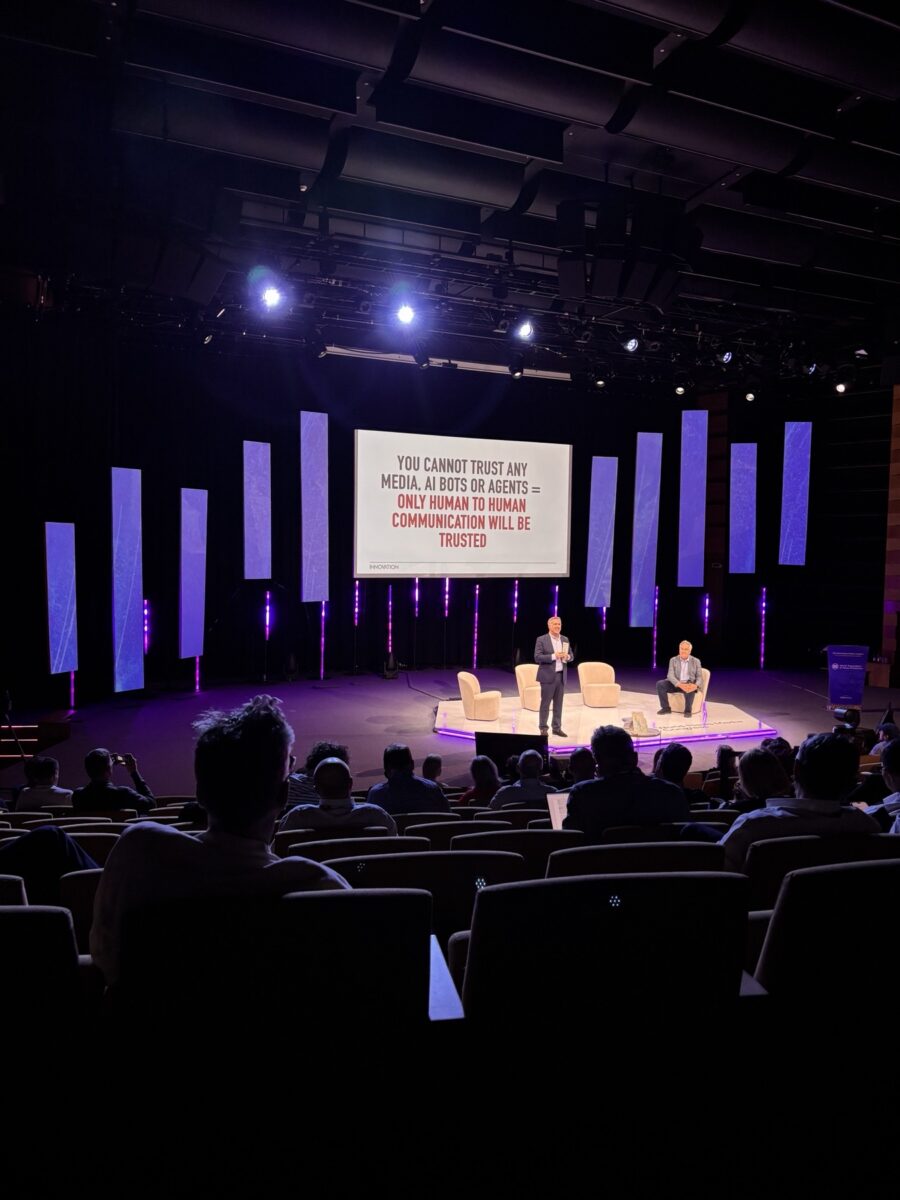
The conversation around artificial intelligence in journalism is no longer theoretical. At this year’s WAN-IFRA World News Media Congress in Marseille, publishers, editors-in-chief, and technology leaders from around the world shared practical insights and data on how AI is reshaping modern newsrooms. The central question is no longer whether AI should be used, but how news organizations can integrate it to improve speed and efficiency without compromising editorial judgment, journalistic integrity, or audience trust.
Regardless of their size, leading media organizations reached the same conclusion: artificial intelligence is not replacing journalists. It is helping them do their jobs better.
The Shift from “AI in Media” to “Media in AI”
Until recently, AI was viewed as an additional tool integrated into editorial workflows for writing, editing, and content distribution.
The new paradigm presented at WAN-IFRA turns that approach on its head. We are moving from “AI in Media” to “Media in AI”, an environment where AI platforms increasingly become the primary interface through which audiences discover and consume information.
In this new landscape, publishers face a different challenge. Their content must be structured in a way that allows AI systems to recognize, understand, and accurately reference it.
Why Are People Using AI?
Consumer behavior analysis, based on OpenAI usage data, reveals a clear trend: practicality outweighs information.
The majority of AI interactions focus on everyday tasks:
Utility accounts for 63% of all use cases, including:
- Practical guidance and advice: 28.3%
- Writing and communication: 28.3%
- Technical assistance: 7.5%
Searching for information represents 18.3% of user queries.
News-related questions account for less than 10%, with only 4% of prompts specifically focused on current events.
The findings suggest that people primarily use AI as a productivity assistant rather than as their primary source of news.
Journalism’s Defensible Territory
Industry experts distinguish between two broad categories of content.
AI-Dominated Content
This includes routine information that AI can generate quickly and efficiently:
- How-to guides
- Weather updates
- Recipes
- Health FAQs
- Routine copywriting
- Simple factual lookups
Competing with AI in these areas offers little strategic value for publishers.
Journalism’s High-Value Zone
The competitive advantage of professional journalism lies elsewhere:
- Original reporting
- Investigative journalism
- Breaking news
- Exclusive interviews
- Opinion pieces
- In-depth analysis
This content is expensive and time-consuming to produce, but it is also what builds long-term audience trust and loyalty.
As Lachezar Dobrev, Product Manager at Net Info, explains:
“Artificial intelligence has become part of the daily workflow in leading newsrooms. Its greatest value comes from freeing journalists to focus on real journalism. AI automates tasks such as transcription, translation, SEO optimization, and information analysis, while journalists remain responsible for fact-checking, adding context, and making editorial decisions.”
The Economics of AI
Early WAN-IFRA research shows that AI is already delivering measurable operational benefits, while its long-term commercial value is still evolving.
Operational Benefits Today
57% report time savings across newsroom operations.
46% report increased productivity.
43% report greater organizational agility.
Expected Business Value Tomorrow
73% expect more efficient newsroom operations.
75% see opportunities for developing new products.
46% anticipate new monetization strategies.
However, 85% of media executives acknowledge that accurately measuring AI’s overall business impact remains a significant challenge.
Declining Search Traffic and New Success Metrics
One of the biggest concerns discussed at the congress was the decline of traditional search traffic.
According to the findings:
58% of publishers report a significant decline in organic search traffic.
72% attribute this decline primarily to AI-powered search experiences.
Only 3.5% of lost traffic is currently being recovered through referrals from AI platforms and answer engines.
From the Web Era to the AI Era
Traditional performance indicators such as impressions, sessions, click-through rates, and SEO rankings are no longer sufficient.
Publishers increasingly need to monitor new AI-era metrics, including:
Query Volume: How frequently users ask AI systems about a specific publisher or brand.
Citation Rate: How often AI models cite a publisher as a trusted source. Current research shows that approximately 36.9% of ChatGPT citations and 34.5% of Gemini citations reference publisher content produced within the previous eleven months.
Share of Authority: The extent to which AI systems recognize a publisher as an authoritative source within a particular subject area.
Grounding Queries and AI Visibility: How often a publisher’s content is used to ground AI-generated responses and reduce hallucinations.
The Role of NewsBuild.ai
NewsBuild.ai was designed to help news organizations adapt to this changing landscape.
Instead of relying on public AI platforms that process editorial knowledge outside the organization, NewsBuild.ai provides a secure environment that automates routine editorial tasks while keeping data, archives, and intellectual property within the publisher’s own infrastructure.
This approach ensures that proprietary content and editorial expertise remain protected rather than becoming part of the training data for publicly available AI models.
Looking Ahead
The key message from WAN-IFRA Marseille 2026 is clear. The future of journalism is not about choosing between humans and artificial intelligence. It is about combining the strengths of both.
News organizations that automate repetitive tasks while allowing journalists to focus on reporting, verification, investigation, and analysis will be best positioned to succeed.
As Lachezar Dobrev concludes:
“The future belongs to media organizations that successfully combine the capabilities of artificial intelligence with high-quality journalism and the trust of their audiences.”